Datter AI — The Input Gate Before AI Spend
Audit corpus redundancy, select a smaller candidate set, and test whether it still clears a task-specific quality floor before paying to process everything.
Runtime and tools
- Python
- Streamlit
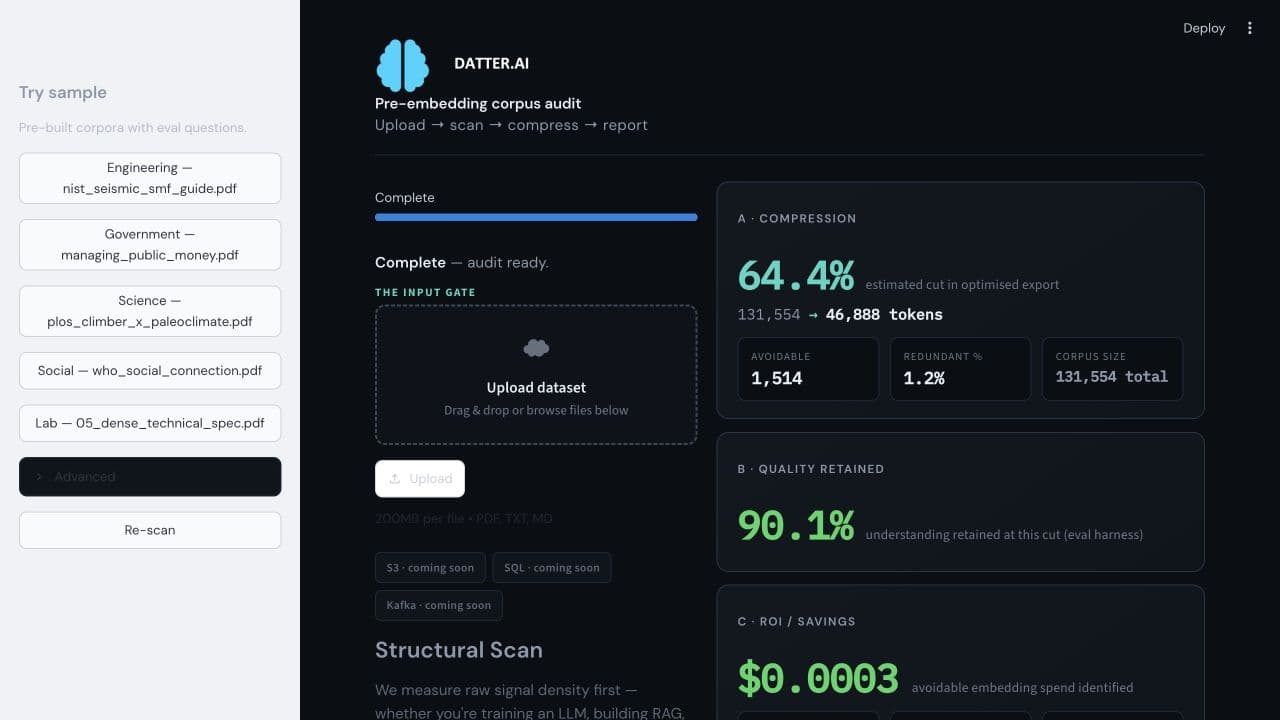
Product at a glance
- Pipeline
- 7 auditable stages
- Decision
- Task quality floor
- Output
- Corpus + audit export
Meet Datter
Proof, not only a compression ratio
Datter treats corpus reduction as a decision that must be checked against the questions the data still needs to answer. The output is a selected corpus plus an audit trail, not an automatic claim that less is always better.

How it works
The seven-stage gate
The README workflow is grouped into five readable decisions here while preserving the complete ingest, chunk, deduplicate, score, select, evaluate, and report pipeline.
- 01Ingest + chunkRead PDF, text, and Markdown into inspectable units.
- 02DeduplicateFind exact and near-duplicate material.
- 03Score + selectPack a candidate set under a token budget.
- 04EvaluateCheck attached questions or a structural proxy.
- 05Export + reportShip the corpus, manifest, and audit trail.
Product
Datter estimates how much of a corpus can be removed while an attached task-specific evaluation remains above a chosen quality floor. It is designed to test data usefulness before paying to embed, label, fine-tune, or repeatedly retrieve from everything.
Why it exists
Document corpora often contain duplication, near-duplication, and material with little relevance to the downstream questions. Compression alone is not evidence of usefulness, so Datter couples selection with an explicit evaluation step and an audit trail.
Working prototype
- PDF, text, and Markdown ingestion with automated chunking
- Exact and near-duplicate auditing
- Token-budget selection with optional task-query relevance
- An offline retrieval-and-overlap quality proxy
- Selected-corpus export and machine-readable audit reports
Build
- Python selection and evaluation pipeline
- Streamlit local interface
- TF-IDF retrieval and token-overlap proxy evaluation
- Pytest coverage and reproducible sample corpora
Maturity
What exists now
| Area | State | Evidence |
|---|---|---|
| Upload and automatic scan | Working | Local Streamlit flow for PDF, text, and Markdown. |
| Deduplication and selection | Working | Baseline heuristic scorer and token-budget selection. |
| Proof loop | Experimental | Current results use an offline proxy; an optional LLM judge is supported. |
| Optimised export | Working | Selected chunks, manifest, and Markdown/JSON reports. |
| External data connectors | Planned | S3, SQL, and Kafka remain interface placeholders. |
Working with a large AI corpus?
Discuss data selection, corpus auditing, and how to test usefulness before committing to downstream AI spend.
Explore the other independent products in Tharm Lab.
All products