
- Pipeline
- 7 auditable stages
- Decision
- Task quality floor
- Output
- Corpus + audit export
Proof, not only a compression ratio
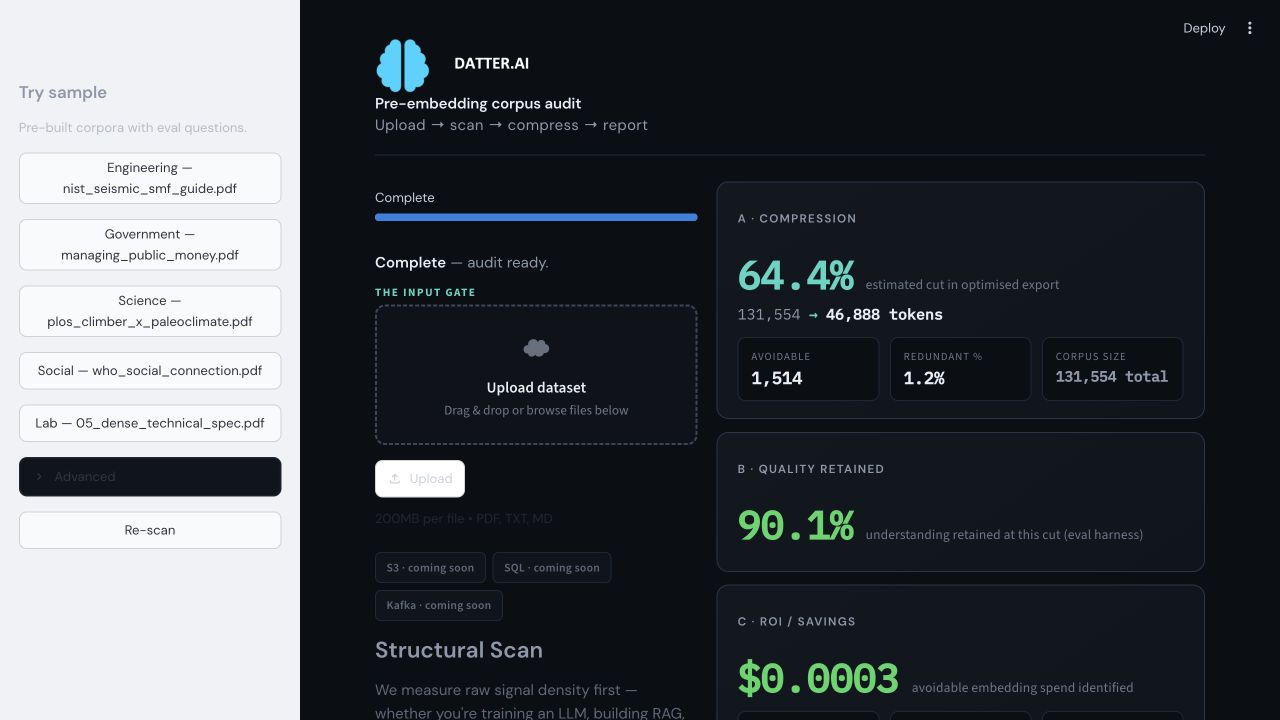
Datter treats corpus reduction as a decision that must be checked against the questions the data still needs to answer. The output is a selected corpus plus an audit trail, not an automatic claim that less is always better.

Datter estimates how much of a corpus can be removed while an attached task-specific evaluation remains above a chosen quality floor. It is designed to test data usefulness before paying to embed, label, fine-tune, or repeatedly retrieve from everything.
Document corpora often contain duplication, near-duplication, and material with little relevance to the downstream questions. Compression alone is not evidence of usefulness, so Datter couples selection with an explicit evaluation step and an audit trail.
- PDF, text, and Markdown ingestion with automated chunking
- Exact and near-duplicate auditing
- Token-budget selection with optional task-query relevance
- An offline retrieval-and-overlap quality proxy
- Selected-corpus export and machine-readable audit reports
- Python selection and evaluation pipeline
- Streamlit local interface
- TF-IDF retrieval and token-overlap proxy evaluation
- Pytest coverage and reproducible sample corpora
Upload and automatic scan
WorkingLocal Streamlit flow for PDF, text, and Markdown.
Deduplication and selection
WorkingBaseline heuristic scorer and token-budget selection.
Proof loop
ExperimentalCurrent results use an offline proxy; an optional LLM judge is supported.
Optimised export
WorkingSelected chunks, manifest, and Markdown/JSON reports.
External data connectors
PlannedS3, SQL, and Kafka remain interface placeholders.